
Health & Safety I Predator Control
The Legal Part
Health and safety is the law in Aotearoa, and the Health and Safety at Work Act 2015 is the rulebook. It says that any "Person Conducting a Business or Undertaking" (a PCBU) must protect the health and safety of workers as well as is reasonably practicable. For community groups, that can include you.
It also matters for the people in charge. Governing officers and managers can be held personally liable if something goes wrong and they haven't taken sensible steps to prevent it.
The best way to cover all this is a written health and safety plan, plus an induction for everyone on the team. That way everyone knows the plan and takes responsibility for their part in it.
Because this is a legal responsibility, and getting it wrong could put your project's future at risk, it's worth bringing in a professional health and safety consultant to build your plan. You'll end up with a solid, lasting system designed around your project.
The four steps from WorkSafe NZ
Group leaders should:
Identify the hazards.
Assess the risks.
Manage the risks.
Monitor how well your controls are working.
What that looks like in practice
Know your patch. Learn the local hazards, like slippery ground, poisonous plants and sharp rocks.
Be ready for emergencies. Know what to do if something goes wrong. St John and NZ Red Cross both run first aid courses around the country.
Use a checklist. It makes it easy to check everyone has the right gear before heading out.
Start with a safety briefing. A quick chat at the beginning of each work session keeps everyone on the same page.
Review and report accidents. If something does happen, learn from it. The Otago Peninsula Biodiversity Group has a handy accident report template you can use as a starting point.
Write a health and safety plan. It protects your people, and it shows you've identified, recorded and prepared for the risks.
Traps & Baits. Handle with Care
Most predator control groups work with traps, baits or both, so here's some practical safety advice for each.
Trap safety
Not sure which trap to use? Our guide to choosing the right trap has links to demo videos for each type.
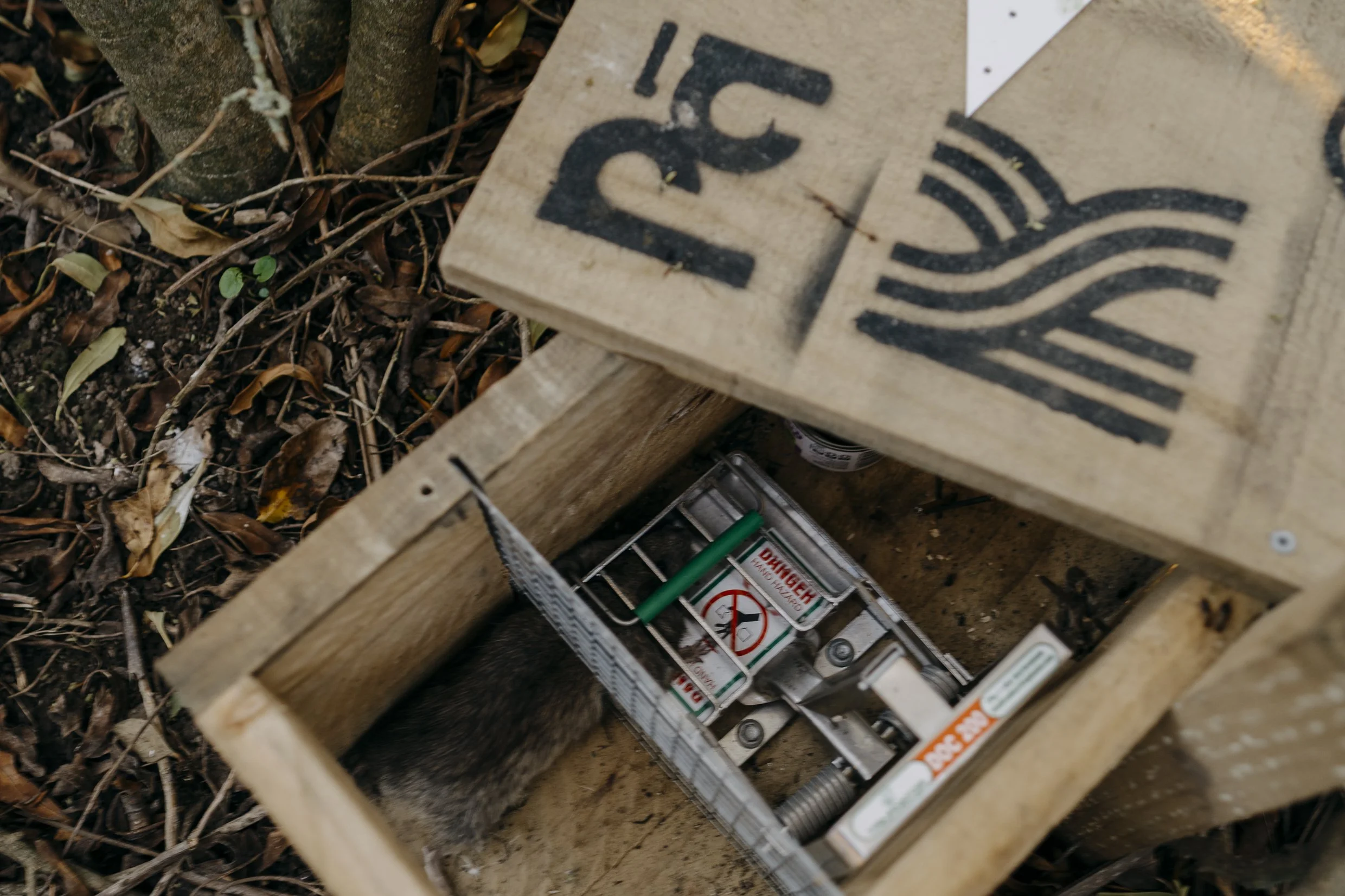
Gloves on for catches. Always wear them when handling anything you've caught.
Dispose of catches tidily. Bury them in the garden, or wrap them in paper and pop them in the rubbish bin.
Working with toxic baits
Toxic baits need extra care. For an overview, read our introduction to bait stations.
Keep bait in bait stations. Every time.
Know your patch. Think about who else could be at risk from secondary poisoning, including people, dogs, livestock and native birds like weka.
Read the label. Read the product label, the manufacturer's instructions and the Safety Data Sheet, and follow them exactly. It's the law, and it protects you, others and the environment.
Glove up properly. Use thick rubber or leather gloves when handling toxins, and when handling traps and carcasses too, to guard against leptospirosis and other diseases. Gloves are a must when dealing with live animals as well.
Keep it tidy. When you refresh bait, check nothing has spilled. If it has, clean it up and dispose of it responsibly away from the site (check the label), so it doesn't affect non-target animals, put pests off the bait or build up in the environment.
If you think someone's been poisoned, call a vet or doctor straight away, or ring the National Poisons Centre on 0800 764 766 (0800 POISON).
Check your licence. You may need a Controlled Substance Licence (CSL) or other approval before you start. If you're unsure, ask the manufacturer or your council's biosecurity team, or hand the job to someone more experienced, or get trained first.
Templates & Resources
A big thank you to our friends at Predator Free NZ, who developed these resources and generously let us share them. Hope you find them useful, and happy trapping. Predator Free NZ has asked us to pass this on:
The information in these documents is a general guide or template. You may need to adapt it or add to it so it fits how your group actually works. Predator Free New Zealand Trust takes no liability for workplace health and safety arising from the use or adoption of this material.
Keen to get trapping?
Keen but not sure where to begin? Get in touch and we'll point you in the right direction.
A Few Safety Basics Before You Start
We want to keep you safe.
Traps are made to kill, so there's always some risk, and the pests we target can carry diseases, which is why doing this work safely matters to us. Your level of risk depends on the job, the crew, your experience, the terrain, the weather and your gear.
Safety is everyone's responsibility, from leaders to volunteers, and if someone is hurt, trustees and leaders can be held responsible for the costs. Below you'll find practical safety tips and guidance on weaving cultural and social awareness into your induction. It's a guide only, so check the links at the bottom of the page for the full picture.
The golden rule is don't get complacent. Safety is a team sport, and everyone has a part to play, whether you're on the governance side, part of the management team, a volunteer, a contractor or a landowner. Keep an eye out for risks and stay mindful while you work. Just because nothing has gone wrong before doesn't mean today won't be the day.
If you're volunteering or working for a group, listen to your group leader, think through the risks and only do what feels safe. Wear the right protective gear, too. Some jobs make it a must (like handling vertebrate toxins), and others make it a really good idea (like wearing gloves when you check traps and clear catches). It's worth running through your tasks and deciding which is which.
See something that doesn't seem right? Tell your group leader. You can use this hazard identification form (PDF) to log it.
Don’t be shy about reporting near misses, the "oops, that was close" moments where nobody is hurt or only a little. They're gold. They often point to something that needs fixing, like extra training or a better way of doing a job. Keep it light and blame-free, but agree on a clear way to record them so everyone can learn. It's a great way to show you value your people and want them to enjoy the work and stay well.

Cultural Induction and Awareness
Just as you'd run through the physical safety basics, your group may also need a cultural induction. It helps protect cultural sites, landmarks and taonga, and shows respect for mana whenua. Usually that means learning the history of the area and the people connected to it, and sometimes opening or closing the work with a karakia or blessing.
It's also a good moment to pause and acknowledge what trapping involves: predator control takes a life. Most people are comfortable with that, but it's healthy to talk about it. Having that conversation keeps us thoughtful, stops the work from becoming routine and helps us stay committed to a humane approach every time.
Cultural inductions should be led by mana whenua who are trained to do this, so reach out to them rather than going it alone.
If you come across something special:
if you find a sacred site or artefact while you're working, stop, secure the area and let Heritage NZ and mana whenua know as soon as you can.